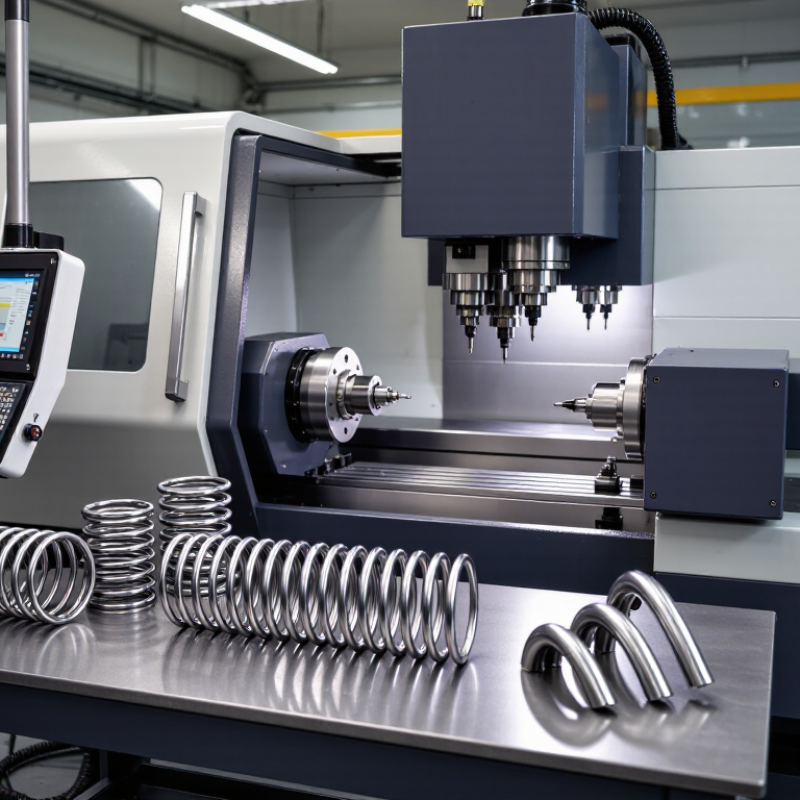
How to Choose the Right CNC Spring Machine
Choosing the right Cnc Spring Machine begins with the spring, not the machine brochure. A compression spring for medical equipment demands different control than a heavy garage-door spring. Wire diameter, material hardness, coil pitch, and required production volume shape the decision. A machine that handles 0.2-millimeter wire may struggle with hardened 3-millimeter steel. That detail matters.
In practical production, operators often compare axis count, forming speed, tooling access, and programming functions. However, more axes do not automatically deliver better springs. They can increase setup complexity and maintenance demands. The best choice supports repeatable forming, stable feeding, and clean changeovers.
Reliable selection also requires evidence. Request sample runs using your actual wire, dimensions, and tolerance requirements. Inspect coil diameter, leg angle, surface marks, and load performance after forming. Ask manufacturers for documented accuracy data, training options, spare-parts support, and service response times. Experienced suppliers should explain limitations clearly, rather than promise perfect results. That honesty is valuable. A factory visit can reveal practical details, such as cable protection, guarding, lubrication points, and operator access. Energy use and floor space deserve attention too. I have seen buyers focus on speed, then underestimate tooling costs and operator learning time. That mistake is avoidable, but not always obvious. This guide examines the technical and commercial questions that lead to a dependable CNC spring production decision.
Define the Spring Types and Production Requirements
Choosing a CNC spring machine starts with the spring, not the machine. Define the spring type, dimensions, material, and tolerance before comparing equipment. Compression springs need accurate coil diameter, pitch, and free length. Extension springs require controlled hooks, leg positions, and initial tension. Torsion springs depend on precise leg angles and winding direction. Conical springs may need changing diameters and carefully managed pitch. Wire forms add bending angles and shaped ends to the production challenge. Do not guess. A drawing should specify wire diameter, coil count, load requirements, surface finish, and acceptable variation.
Production requirements determine whether the machine is practical for daily work. Record the expected batch size, hourly output, setup frequency, and material range. High-volume production needs stable feeding, repeatable motion, and quick tooling changes. Small batches may benefit more from flexible programming than maximum speed. I have seen capable machines struggle when operators ignored changeover time. That assumption fails. Check whether the equipment supports the required forming operations, not just the spring’s basic shape. Trial production should measure diameter, pitch, free length, load, and hook geometry. Simple gauges help, but critical springs may need calibrated force testing. Keep sample parts and inspection records from each batch. They reveal drift before rejected parts fill a box. A slower machine can be the better choice when it produces consistent parts with less adjustment.
Match Machine Specifications to Spring Design Needs
How to Choose the Right CNC Spring Machine
Match the machine to the spring design, not the other way around. Start with wire diameter, outside diameter, pitch, free length, and required spring force. These values define the machine’s working range. A machine rated for thin wire may struggle with heavy compression springs. The result can include unstable feeding, uneven coils, or damaged tooling.
During production trials, check the number of forming axes and available tooling positions. Extension springs may need controlled hooks, while torsion springs require accurate leg angles and tight bend control. For small medical or electronic springs, repeatable feeding matters more than maximum speed. For larger springs, motor torque and frame rigidity deserve closer attention. Measure samples with calibrated gauges, then record the settings and results. Small errors become expensive.
Do not rely only on a catalog range. I have seen a design fit the listed specifications but perform poorly during continuous production. Material hardness, surface finish, and changing coil pitch affected the outcome. A short trial using the actual wire can expose these problems early. Ask whether the machine supports automatic compensation, easy setup changes, and accessible maintenance points. Operators should be able to adjust feed length without guessing. That sounds basic. It is not. Leave room for future spring variations, but avoid paying for capacity your current designs cannot use.
Evaluate Control Systems, Tooling, and Automation Features
Choosing a CNC spring machine starts with its control system, not its advertised speed. A reliable controller should support multi-axis synchronization, recipe storage, real-time alarms, and quick parameter changes. In a busy workshop, a clear screen can prevent a costly setup mistake. The International Federation of Robotics reported 541,302 industrial robot installations worldwide in 2023. That figure shows how quickly automated production is expanding. However, automation without stable control logic may only produce errors faster. I have seen operators lose hours correcting a small feed-length entry.
Tooling deserves equal attention. Check whether the machine accepts interchangeable wire guides, coiling tools, cutters, and forming attachments. Tool changes should be repeatable, with visible reference points and minimal manual alignment. The wrong tooling design can damage surface finishes or create inconsistent spring angles. The 2024 Deloitte and Manufacturing Leadership Council smart manufacturing survey found that 86% of manufacturers expect smart manufacturing to become a primary competitiveness driver within five years. Yet, many reports focus on connected factories, not the practical difficulty of maintaining tools on the shop floor. That gap matters.
Automation features should match actual production volume. Automatic wire feeding, tool compensation, inspection sensors, and production monitoring can reduce operator workload. They can also increase maintenance demands. Look for fault history, remote diagnostics, and easy access to wear components. The 2024 World Robotics report recorded more than four million industrial robots operating globally. Bigger numbers do not guarantee better output. Test a sample spring, measure cycle stability, and question every promised percentage.
How to Choose the Right CNC Spring Machine - Evaluate Control Systems, Tooling, and Automation Features
| Evaluation Dimension | Important Specification or Feature | Typical Practical Range or Requirement | Why It Matters | Recommended Selection Check | Priority |
|---|---|---|---|---|---|
| Control System | Number of controlled axes | Common configurations range from 4 to 12 axes; more complex wire forms may require additional independent axes. | Independent control of feed, coiling, pitch, cutting, and auxiliary tooling improves the machine’s ability to produce variable-pitch and shaped springs. | Match the required axes to the most complex part in the production schedule, not only to the current standard spring. | High |
| Control System | Programming and data storage | Look for graphical parameter entry, recipe storage, revision control, and the ability to back up programs through a standard data connection. | Clear programming reduces setup errors and makes repeat orders easier to reproduce. | Ask for a live demonstration of creating, editing, saving, backing up, and restoring a spring program. | High |
| Control System | Motion synchronization | Servo-driven axes should provide coordinated electronic motion with adjustable speed and acceleration profiles. | Synchronized motion supports consistent pitch, diameter, end geometry, and cut-off timing at production speed. | Run a sample program containing different pitches, coils, and end treatments rather than testing only a simple compression spring. | High |
| Control System | Operator interface | A color touch interface with alarms, parameter guidance, access levels, and multilingual support is generally preferable. | Good interface design shortens training time and helps operators identify setup or maintenance problems quickly. | Check whether common adjustments can be made without editing low-level motion parameters. | Medium |
| Control System | Quality monitoring | Useful functions include real-time fault alarms, production counters, cycle-time records, and trend monitoring for critical dimensions. | Process information helps detect tool wear, material variation, and drift before a large batch becomes nonconforming. | Confirm which process values are recorded, how long they are retained, and whether data can be exported for quality documentation. | High |
| Wire Capability | Wire diameter range | Select a range that covers the intended material and diameter mix; many general-purpose machines are configured for small- to medium-diameter wire. | Wire diameter affects required feed force, tooling strength, cutter capacity, spring index, and achievable production speed. | Compare the actual minimum and maximum diameters for your materials, including coated, stainless, or high-carbon wire where applicable. | High |
| Tooling | Tool-change method | Quick-change holders, repeatable tool locations, and clearly documented setup references reduce changeover time. | Tooling changes can consume significant production time when many spring families are manufactured in small batches. | Measure a complete changeover using a representative job and include calibration, trial pieces, and first-article approval. | High |
| Tooling | Tool material and wear resistance | Cutters, coiling points, guides, and pitch tools should be selected for the wire material, hardness, surface finish, and production volume. | Tool wear can change spring dimensions, increase burrs, and create unplanned interruptions. | Request expected wear indicators, recommended replacement intervals, sharpening procedures, and critical spare-part lead times. | High |
| Tooling | Tool adjustment range | Verify the available adjustment for coiling points, guides, cutters, pitch tools, and end-forming attachments. | A wide adjustment range allows one machine platform to support more spring geometries without custom mechanical modifications. | Compare the tooling layout against drawings for the largest, smallest, longest, and most complex parts. | High |
| Automation | Automatic wire straightening and feeding | Look for controlled straightening, stable feed tension, anti-slip rollers, and overload detection. | Consistent wire presentation is essential for repeatable diameter, pitch, and end position. | Test the machine with the actual wire sizes and surface conditions used in production. | High |
| Automation | Automatic cut-off and end forming | Available functions may include programmable cut-off, closed or open ends, reduced ends, hooks, loops, and special bends. | Integrated forming reduces secondary operations, handling, and the risk of dimensional variation between processes. | Confirm that the required end geometry can be produced in one setup and inspect cut quality on finished samples. | High |
| Automation | In-process inspection | Options may include laser measurement, camera inspection, force checks, length checks, and automatic rejection of out-of-tolerance parts. | Automated inspection reduces dependence on manual sampling and supports stable production of safety-critical components. | Define the critical-to-quality dimensions, measurement tolerance, inspection frequency, and reject-handling method. | Medium |
| Automation | Material handling and collection | Consider controlled part discharge, conveyors, collection bins, separators, and automatic counting. | Careful handling prevents tangling, surface damage, and mixed lots while reducing operator intervention. | Check whether finished parts can be collected without damaging hooks, coils, coatings, or formed ends. | Medium |
| Performance | Production speed versus usable output | Evaluate parts per minute under real operating conditions rather than relying only on an unloaded maximum cycle rate. | Setup time, inspection, material loading, tool wear, and rejects determine effective capacity. | Calculate output using a representative job, including changeover, trial pieces, downtime, and quality losses. | High |
| Performance | Dimensional repeatability | Require documented repeatability data for length, outside diameter, pitch, end angle, and other critical dimensions. | Repeatability is more useful than headline speed when springs must meet tight functional or assembly requirements. | Run multiple batches after a setup change and compare measurements using the same inspection method used in your facility. | High |
| Maintenance | Access and preventive maintenance | Prioritize accessible lubrication points, guarded service areas, diagnostic messages, and documented maintenance intervals. | Simple maintenance improves uptime and reduces the risk of premature wear in feed, tooling, and motion components. | Request the maintenance schedule, lubrication specifications, service access requirements, and recommended spare-parts list. | Medium |
| Safety | Guarding and safety functions | Verify fixed guards, interlocked access doors, emergency stops, safe restart behavior, and protection from wire and tooling hazards. | High-speed wire and moving forming tools can create serious mechanical hazards if access is not controlled. | Review the machine risk assessment and confirm compliance with the safety requirements applicable to the installation location. | High |
| Integration | Connectivity and production reporting | Useful options include standard industrial network communication, remote diagnostics, recipe transfer, and production-data export. | Connectivity supports traceability, maintenance planning, and integration with manufacturing or quality systems. | Confirm supported protocols, cybersecurity controls, data ownership, and whether connectivity requires additional hardware or software. | Medium |
| Total Cost | Lifecycle cost | Include machine price, tooling, installation, training, energy, consumables, maintenance, software, inspection equipment, and downtime. | The lowest purchase price may not provide the lowest cost per acceptable spring over the machine’s operating life. | Compare cost per good part and expected payback using realistic utilization, labor, scrap, maintenance, and changeover assumptions. | High |

Compare Machine Accuracy, Speed, Capacity, and Flexibility
Choosing a CNC spring machine starts with measurable accuracy, not attractive specifications.
Check wire-feed repeatability, pitch control, and forming-axis positioning. ISO 230-2 provides accepted methods for testing positioning accuracy and repeatability. Ask for test results using your actual wire diameter and spring geometry. A machine accurate on thin wire may struggle with hardened wire. Small errors become costly in long production runs.
Speed matters only when quality remains stable.
Compare forming cycles, acceleration, loading time, and changeover minutes.
The International Federation of Robotics reported 541,302 industrial robot installations worldwide in 2023, in World Robotics 2024. That growth reflects stronger demand for repeatable automation.
However, faster motion can increase vibration, tool wear, and rejected springs. I have seen impressive cycle claims fail during continuous production. Real factory trials matter more than brochure figures.
Capacity should cover today’s work and a realistic future range.
Review wire diameter, maximum outside diameter, spring length, tooling space, and motor load. Flexibility also matters. Look for programmable axes, quick tooling changes, recipe storage, and simple diagnostics.
Tips:
Run a sample batch for several hours. Measure pitch, diameter, and free length at regular intervals. Record changeover time, scrap rate, and operator adjustments. Leave spare capacity; maximum load is not a comfortable operating point.
A spreadsheet can mislead. Use production evidence.
Assess Maintenance, Safety, Cost, and Supplier Support
How to Choose the Right CNC Spring Machine
Choosing a CNC spring machine starts with maintenance, not just production speed. In real workshops, dust, wire fragments, and lubricant quickly collect around guides and tooling. Select a machine with accessible covers, clear lubrication points, and simple error diagnostics. Ask how often operators must replace cutting tools, sensors, and belts. A removable tooling area can reduce service time. Small details matter.
Safety requires practical inspection. Check guarding, door interlocks, emergency stops, and automatic wire-feeding protection. Operators should see the forming area without reaching into it. Request documented training materials and maintenance procedures from the supplier. I have seen buyers focus on output figures and overlook awkward access during setup. That judgment can be expensive. A safer layout may also reduce fatigue during long shifts.
Compare total ownership cost over several years, including installation, training, energy use, tooling, and downtime. A lower purchase price may hide costly service delays. Ask whether spare parts are stocked locally and how quickly technical support responds. Get response times in writing. Reliable suppliers should explain software updates, remote assistance, warranty limits, and technician availability. Speak with current users if possible, but question overly perfect testimonials. They may not reflect difficult production weeks. I would also test sample coils before ordering, because a machine can perform well in demonstrations yet struggle with your actual wire diameter, pitch, or tolerance.